With Laurier Mandin
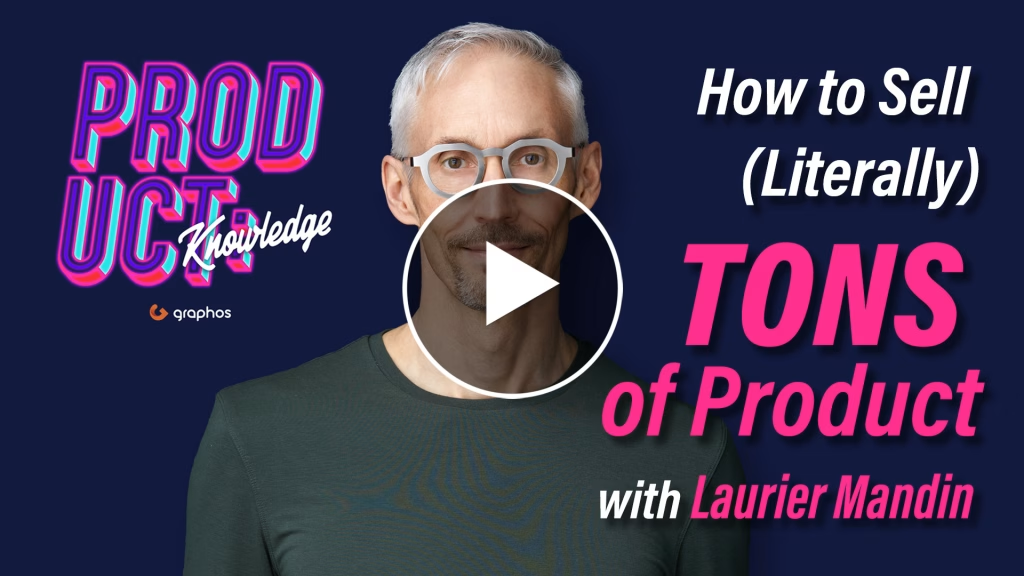
What does it actually take to sell tons of product: not as a metaphor, but literally by the truckload?
In this solo episode of Product: Knowledge, Laurier Mandin shares real-world product marketing case studies where slow or stagnant sales turned into explosive growth. In one case, a barbecue product went from zero sales to 180 tons sold in just a few months.
These examples reveal a consistent pattern: the products that win don’t rely on claims—they prove their value in ways buyers can immediately understand.
This episode breaks down how to create that kind of proof, why it works, and where even successful products can fail.
Episode Highlights
- 00:00 – Introduction: selling by the ton
- 01:11 – Barbecue product: zero to 180 tons
- 02:04 – Why the original ad failed
- 02:19 – The demonstration breakthrough
- 03:02 – SmartFish: proof in a crowded market
- 03:52 – Why proof converts
- 04:00 – Blendtec and viral demonstration
- 04:56 – When proof isn’t enough
- 05:01 – Parallel Pillow: skepticism as strategy
- 06:04 – BzzzzKill: credibility and community
- 06:49 – The failure behind success (economics)
- 07:44 – What AI cannot do
- 10:02 – The shared pattern behind winning products
Buy “I Need That” and get Laurier Mandin’s daily Need Feed emails: LMandin.com
Episode Transcript:
Laurier Mandin: Hey product people
If you’ve ever wondered what it actually takes to sell literally tons of product — not as a metaphor, but by the truckload — this one’s for you.
Because when a product really takes off, the unit of measure stops being pieces. It becomes weight.
Welcome back to Product: Knowledge,
the podcast about creating and marketing products people truly need. I’m Laurier Mandin, founder and principal consultant at Graphos Product.
It is possible to sell literally tons of a new product.
I know, because I’ve seen it happen.
Today, I’ll tell you how some real-world products went from flat sales to explosive growth — and the strategies we used to make it happen.
We’ll talk about sizzle videos, viral proof, skeptical buyers, and how to turn all of that into momentum you can measure not in pounds but in tons.
Plus, and most importantly, I’ll tell you the one thing you absolutely need that you can’t get from AI, or even by watching every video on YouTube. And how to get it.
Let’s start with a product that really caught fire.
In 2020, a client came to us with an outdoor cooking product called SearBQ.
Part griddle, part press. It was used on a gas barbecue, and promised to deliver double the flavor, in half the time.
They’d already produced a high-budget video — professional actors, humour, solid production values.
It looked pretty good on screen.
But it didn’t convert.
I wanted to shoot a fresh demonstration video, but there wasn’t budget for that.
So, we went back to what we did have: real food on a real grill.
We found the best recipe video, tightened the edit, amped up the sizzle sound, and focused on the moment — a knife cutting into perfectly cooked, beautifully juicy steak.
Within a few months, we went from no sales to over a million dollars.
We literally sold tons of SearBQs.
And I’ll tell you a twist in that story later — because there’s a lesson there too.
But first, a product that started in deep water.
It was for a fishing lure we called SmartFish.
A brilliant innovation — it could balance underwater on the head of a nail.
But the fishing-lure market is more crowded than a live well on derby day.
We knew a beautiful product in great packaging wouldn’t be enough.
So instead of describing what made it great, we showed it in action.
We cut underwater footage of big fish hammering the lure. Again and again.
We showed pro anglers — men and women — proudly holding their catches, with SmartFish still hanging from the fish’s mouth.
No spin. Just real-world evidence.
And once the proof was visible, the buyers didn’t need to be convinced.
SmartFish never looked back. They’re still making, and selling, truly remarkable lures.
That’s the big takeaway here: when proof is undeniable, the customer gets on board with you.
This isn’t a new idea. One of the best demonstration examples came from a blender company called Blendtec.
Their founder started a YouTube series called Will It Blend? where he dropped things like golf balls, iPhones, and even a rake handle into the blender.
It was ridiculous, and sometimes felt dangerous. But it proved something instantly, without saying it: that blender was unbelievably powerful.
Sales exploded.
Because the demonstration made the promise undeniable.
But even solid proof isn’t always enough.
Like what happened with the Parallel Pillow.
It was a truly excellent product — comfortable, supportive, beautifully made — but entering a world where hundreds of “premium” pillows claimed to do the very same things.
Parallel’s difference was both emotional and technical.
For every pillow sold, one was donated to a person in need.
We told that story visually — real people, from children to seniors, clutching their donated pillow.
But we didn’t stop at emotion.
We highlighted the silver-ion technology that naturally repels bacteria and dust mites, and its thermal regulation that keeps you cool when it’s hot and warm when it’s cold.
Then we leaned into skepticism.
Our headline?
A $150 Pillow?
Exactly — and worth every penny.
That single line, born from social-media doubt, became our best-performing ad.
It turned the question everyone was asking into the answer they needed.
And then there’s BzzzzKill — the little device that eliminates hum in Stratocaster guitars.
Guitarists are famously skeptical about fixes like this. They’ve seen “buzz-fix” products before, and most of them didn’t live up to hype.
So we started with credibility.
We asked Joey Landreth, the award-winning singer-songwriter, to show what BzzzzKill could do. His demo went viral with guitarists.
Then Guitar World’s tech editor reviewed it — and his endorsement changed everything.
Before long, even the Fender Custom Shop co-founder decided to include BzzzzKills in his Artist Series guitars.
We went from market skepticism to a wildfire of word-of-mouth.
That’s when the buzz about stopping buzz took off.
Hey, remember SearBQ?
After all that success, the founder eventually told me he was winding down online sales.
The reason wasn’t lack of demand or a faulty product — it was weight.
Each unit shipped at almost 50 pounds, and the economics collapsed under courier costs and free-shipping expectations.
Steel prices spiked. Shipping costs tripled. Media costs went nuts. Tariffs blew up. And margins went negative.
It’s a reminder: even the best marketing can’t overcome a broken business model. Even if it seems fine on launch day.
Always work out every cost — from materials to delivery — before you scale. And build in contingencies for things outside your control.
5.5 What You can’t do yourself
So I promised I’d tell you something you can’t do with AI, or even if you could consume every single content piece about product marketing on the internet?
Here’s what I was talking about: objective expertise.
There’s an adage I love that you can’t read your own label from inside the bottle. With your product, you are just not able to see it objectively, the way an outsider does. You are biased, and you can’t help it. You always have been. Everyone sees their baby as beautiful.
And AI can’t help much when it comes to seeing why your product stands out to living, human decision-makers. It has never felt the pain of wasting money. It has never felt the joy of achieving the Coveted Condition, the long-term desired future state your product delivers. It will never fantasize about the potential that comes from owning your product, or have an AHA moment in the shower that makes it all take off.
It also can’t have an original idea, at least not yet. Everything an AI tells you is something that’s been done before. But even the most successful campaigns of all time can’t be repeated.
If you’re trying to position your product in a silo, or using AI tools to do it, you might never sell tons of product. AI is good at a lot of things, including making realistic-looking mirages.
Don’t fall for it. You’ve got way too much to lose. I’m not saying you need to hire my team at Graphos Product. Just get objective, experienced human expertise. You’ll be glad you did.
So what ties these stories together?
Each one won differently — but they share a mindset.
SearBQ succeeded because we showed impact instead of polish.
SmartFish proved its worth through irrefutable evidence.
Parallel Pillow turned skepticism into belief by pairing empathy with innovation.
BzzzzKill built credibility first — and let community amplify the rest.
They all did one thing the same way:
They showed, not told.
They replaced “we’re great” with “see for yourself.”
And they made the story effortless to understand.
That’s how you sell literally tons of product.
[Music fades in]
You can find the full transcript and show notes at graphosproduct.com,
and sign up for my daily Need Feed emails or grab a copy of I Need That at lmandin.com.
If you found this episode helpful, share it with someone building something amazing — they might be one bold edit, one proof point, or one clear story away from their own breakthrough.
Thanks for listening. I’m Laurier Mandin.